Self-taught Projects
Linux Workstation (Bazzite)





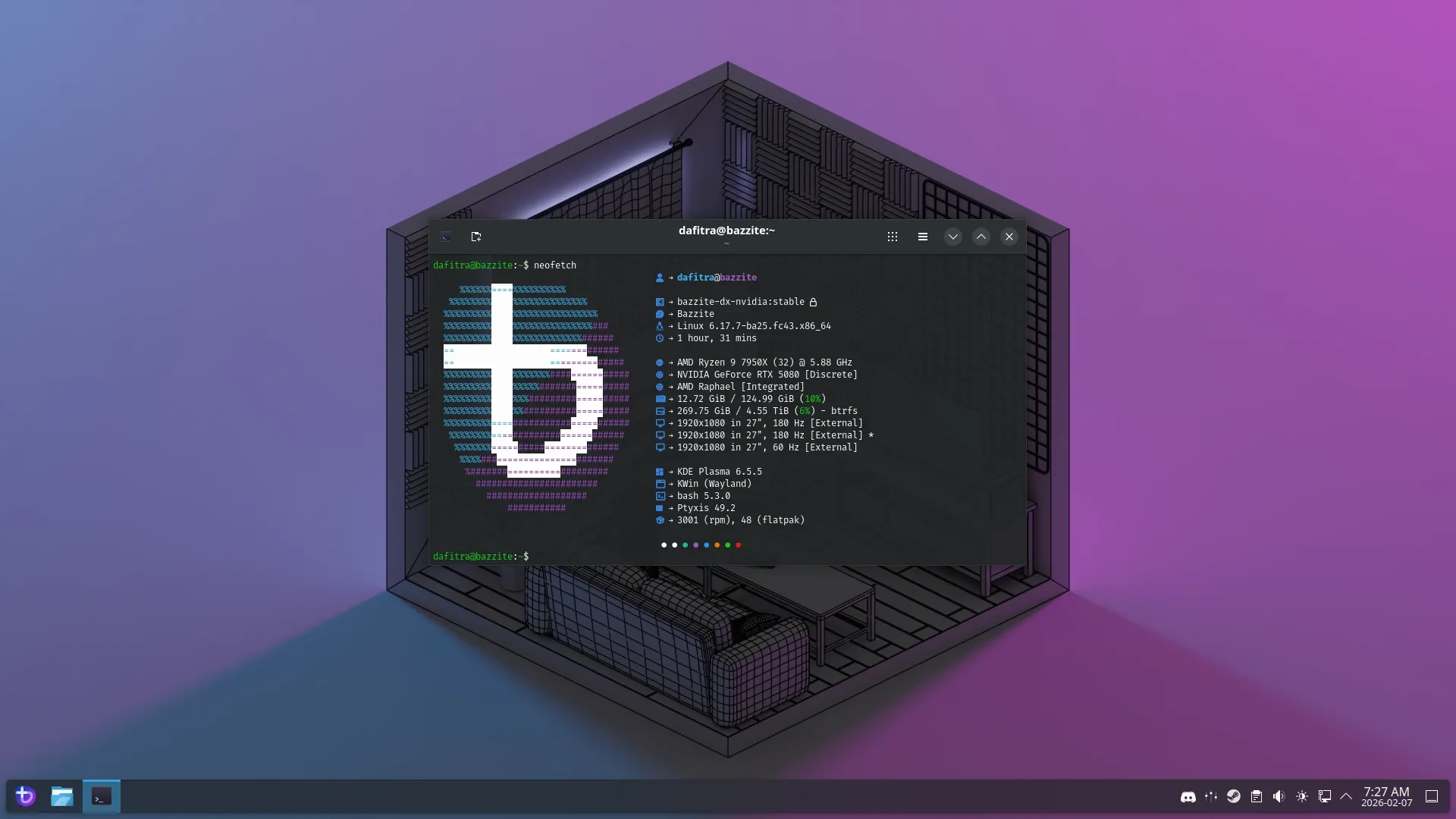
A personal PC has been running on Bazzite since early February 2026 using Bazzite DX image, following a migration from Windows with targeted system and tooling customizations.
What's Actually Set Up
- RTX 5080 supported out-of-the-box by Bazzite. No rituals, no tears.
- PipeWire filter chains configured for 7.1 surround sound using the SADIE KEMAR preset. Ears are happy.
- Isolated AI workload under Distrobox, because Bazzite's immutable host discourages direct modification, and the rules were followed. Mostly out of respect. Partially out of fear:
- A custom-built FFmpeg with full codec and feature support, as well as hardware acceleration, based on the latest upstream version. Overkill? Absolutely.
- PyTorch compiled from source to drag CUDA 13 runtime into existence.
- SageAttention3 compiled, which demands CUDA 13 toolkit, Triton, and a from-source Python build as entry fee. Bazzite DX's Python ships without CPython and LibFFI, so LibFFI also got the from-source treatment. Perfectly normal stack of dominoes.
- SageAttention2 also installed as fallback, for transformers still pretending SageAttention3 doesn't exist yet.
Why Migrate?
- Hardware utilization and performance
Ongoing use of Ubuntu on a secondary work laptop since 2023 showed measurable gains in battery life, performance consistency, and system-level customization. That evidence made the primary workstation an obvious next candidate. - Vendor lock-in from Windows-only software
Core functionality is routinely gated behind proprietary, subscription-based tooling. A notable example is Beyerdynamic Immerse charging annually for 7.1 virtual surround. Windows-side workarounds lean on OSS layers like HeSuVi, while Bazzite treats this as a first-class feature via PipeWire, includingujust setup-virtual-surround.
Peripheral ecosystems often require heavyweight vendor software just to expose basics like DPI or profiles. Linux alternatives such as OpenRazer and Input Remapper deliver the same functionality without the ongoing hostage situation. - Excessive telemetry and bundled features
Persistent background telemetry and preinstalled AI slop apps that are unrelated to user workflows are enabled by default. Meaningful mitigation typically depends on third-party utilities (e.g., O&O ShutUp10) rather than supported, system-level controls. - Update instability
Mandatory updates have a habit of introducing regressions or invalidating existing configurations. Bazzite uses atomic updates with rollback support, making experimentation far less exciting in the wrong ways. - Misconceptions around NVIDIA on Linux
Claims of poor NVIDIA support are outdated. NVIDIA provides official Linux drivers and tooling with feature parity. Bazzite ships with the driver preinstalled and preconfigured, removing the manual setup obstacle course.
Why Bazzite?
- Why not use Windows LTSC?
LTSC removes the ads, not the leash. Same plumbing, fewer stickers. It's still Windows and requires licensing. Also still quietly steering things back to defaults nobody explicitly invited. - Maintenance-free system
Atomic images. Update misbehaves? Reboot into yesterday. No drama, no registry archaeology, no "hope this works" energy. - Beginner-friendly ;)
Some people need spiritual validation from compiling their own kernel. Bazzite ships with proprietary GPU drivers baked in and handles the heavy lifting. Yes, that means fewer rites of passage. Tragic. - Gaming performance
Modern AAA releases lean hard on frame generation and reconstruction tricks. When half the FPS is synthetic anyway, chasing tiny distro deltas feels academic. FPS can be capped when FG isn't available, hardware stay under 70 °C and the electric bill remains pleasantly unremarkable.
Any Quirks?
No distribution delivers flawless, out-of-the-box compatibility across all workloads. Occasional hiccups still appears:
- Gold-rated games
Titles marked Gold on ProtonDB may still require minor tweaks or additional dependencies for optimal behavior. For example, Clair Obscur: Expedition 33 hides most graphics settings unlesssd0(disable Steam Deck mode) is added to launch parameters. - Ray tracing
RTX features may intermittently fail in certain games following NVIDIA driver updates. The practical workaround is to roll back to a known-good driver version until the regression is resolved. - Anti-cheat
Some games listed as Denied or Broken on AWACY are generally unplayable (looking at you, EA). In Denied cases, developers have explicitly chosen not to enable or support Linux-compatible anti-cheat solutions. - Proton updates
Steam's Proton updates drop frequently and sometimes have generous file sizes. Ideal for transforming a quick launch into an extended lesson in patience and network endurance. - Wine-based games
Audio occasionally decides to assert dominance at full volume, with in-game sliders cheerfully doing nothing. ALSA swaps and the usual Gold-rated ritual tweaks apply. - Atomic trade-offs
Bazzite's image-based, immutable core keeps low-level tinkering on a tight leash. Fewer ways to quietly wreck the system, fewer late-night heroics. Stability stays boring. Ego occasionally sulks.